Badly Photoshopped Image wins Nikon Photo Prize

0

This is an image of a rooftop ladder where a photographer claims he shot a silhouette of a plane though while waiting for a plane to fly over.

It won a Nikon prize in Singapore.

Goes to show that you only need an ounce of photoshop skills to win something online.


Using photoshop, the image was detected to be fake. But Nikon refuse to admit its error. This sparked a whole slew of fake pictures that became a meme.


Including this one of a Tie Fighter. 

So what do we take from this? Obviously a picture is worth a thousand words but with Photoshop, it's worth probably far more. 

I recently had a conversation with a camera retailer who joked that these days, you don't have to be a top notch photographer to get jobs...as long as your photoshop skills are excellent that's what clients want. 

Looking back, what he said is true. I mean, which of you out there who shoot weddings and commercial photos would refuse to use Photoshop to remove any imperfections?

Running a Photo Contest is a fatal affair for a Brand

During my time with Sony, I was given a chance to run a photo contest and we did. It was a difficult decision and we had to take Photoshop into account. 

You had to send in copies of your originals which were short listed and later, asked for the RAW files. The contest itself was free to enter. We only wanted pictures that told a story and that was it. There was a lot of work involved and many people were engaged for a rather simple project like this. 

All because we wasted to be sure that whoever won the prize deserved it. 

When brands like Nikon give out prizes to undeserving photographers, it gives the impression that Nikon values Photoshopped images more than real ones and this is VERY bad for the brand. 

Nikon was in no doubt not in a big hurry to remove the image from its Facebook page or for that matter cancel the award. They were lost for words. Sort of like shooting yourself in the foot and then putting your foot in your mouth. 

This is why having a photo editor run a contest is crucial. And these are not your average Tom, Dick or Harry. They are experts in detecting fraud and in another time, they would be known as fraud detectors. Why do Brands have to do this? Because Photoshop exist. 

Photoshopping is not illegal for Stock Image Sales

Many a time, Stock Image Banks or Libraries do not make it clear on the subject of image manipulation because they encourage it. 

Stock images sell because it is a cleaned imaged, that means an image that has been created or staged to the point that it appeals to buyers. 

If you have brands in the background or foreground, it is up to you to remove them. Once it is done, it because more marketable as the buyer doesn't need a copy of Photoshop to clean it up for their use. 

A less than perfect photo isn't enough. It has to be perfect, not for viewing but for commercial use. 

Once photographers get into the habit of this, then firing up Photoshop becomes a routine affair for processing photos rather than use Image Editors like Lightroom. 

Photography is about the capture of Images

This is where I have problems with the above understanding. You become less of a photographer and more of a photo manipulator. 

You then have to ask yourself where you stand. 

I don't have a copy of Photoshop sitting on my computer for the last five years, and have allowed my Photoshop skills to depreciate with each new version of Photoshop CC. Do I miss it? 

Not one bit. 

I find that I enjoy my photography more either using a mobile device or on an analog camera. I don't even use my digital cameras to shoot anymore. 

The purity of the experience is in the art of making photos with a camera and not with a computer. I don't think of capturing less than perfect photos because I know I can fire up Photoshop to change things around in an image. 

This is a very important lesson if you want to learn the art of Photography in a digital age. 

You have to ask yourself if you are doing it for profit or for your own sense of enjoyment before embarking on it and if you say the former, that is to sell your works, then you probably need to ante up on your Photoshop skills more than your Photography skills. 

Photos can also be sold as framed artworks so this works to your advantage if that is your goal. 

The the purist who just wants to enjoy Photography, my advice is for you to take up a film camera before you shoot with a digital one. The experience and skills you pick up from this contributes exponentially to your skills later and you won't regret a moment of it. 


Corbis sells out to VCG for a song....

0

It is official, Corbis has sold out to Visual China Group, the same group that bought out 500px over a year ago.

Corbis sold for less than it was imagined, with rumors flying saying it was below US$100 million and with a library of 50 million images, that sounds like a deal that can only made in China.

Getty has an agreement to sell Corbis images outside of China so that won't affect world wide sales for photographers.

Photographers weren't too happy as they were not informed of the sale and some have even started to pull their images out from the library. But to say that Chinese are going to abuse the issue is misstating the facts.

Decline of Revenue for Stock Images 

With lax to no regulation by stock image agencies over the use on the Internet, the decline was to be expected. For the record, world wide copyright enforcement for stolen images is extremely low and DCMA takedowns cannot be enforced with servers hosted outside of the US.

Even with personal images, the law is on the side of the offender for US cases. You cannot claim a copyright if you didn't file for copyright protection in the US. This is a costly affair and with your images worth only a tad more than the royalty image, getting a lawyer to sue the offender just doesn't make sense.

To make matters worst, even if rights managed photos are exploited, stolen or misused, stock image agencies still fail to perform any type of regulation to ensure rights are not abused.

This means that a offender can buy a lower quality photo for web use and still blow it up to wall size for use on rooms and walls.

Photographers who own these photos do not know the buyers and this is kept confidential. If a rights use issue does crop up, offenders normally get a slap on the wrist rather than pay any penalty since laws are opaque when it comes to copyright from country to country.


Worst time for Stock Photographers

It is hard to imaging who would want to carve a career in stock photography when royalty free and crowd sourced photos are disrupting the markets.

Camera gears are getting more expensive, and to be kitted out with the latest equipment for professional photography would be a very difficult business proposition.

This is not to say that you can't make money from ad hoc photography services be in commercial photography or weddings. It is how much you can make that determines your future in the business.

Stock photography cannot be treated as a mainstream  income but for beer money. So enjoy the photography while keeping in mind the weekend booze could be more memorable if you earned a little more.


Noob tips for Concert and Stage show Photography

0

I was watching this TV program on Australia's ABC channel where a few selected a candidates who were photographers of other genres to test their skills on something they have never done. 

Fortunately for me, I have done a whole load of different genres in my lifetime so coming across these challenges weren't a problem. 

What struck me was that the candidates weren't sure if the ISO handling would hold up in a shoot with a Canon DSLR, something they could have found out using the Internet. 

For me at least, I knew that any present day DSLR worth it's grain in salt would be able to handle 3200 ISO without breaking a sweat. High ISO grain should not pose a problem but lighting or White Balance can. However you only find that out during an actual shoot when the lighting comes on. 

Besides these expected challenges, shooting in concert or stage scenarios is pretty much like shooting motor sports. Let's examine the details. 


Telephoto Lens with a Wide Open Aperture


Yup. Without it, you're done for. You need a minimum of 200mm with a f/2.8 aperture. Any less would warrant problems. This has to do with how far or how close you are from the stage. Fast shutter speeds allow you to free movement, slow ones blur it. This is the same creative methods used by sports photographers. The aperture is used not only for bokeh effects but also for shutter speed control. A higher shutter speed used in a wide open aperture will compensate for low light conditions. 

Bring along a Wide Lens


For environment shots, you need a wider lens. How wide depends on the stage. In large scale stadium style a wide area shot captures the mood and audience during performance while in the pit area (official photographer's pit access) the wider lens will also go some way to capturing the whole performance on stage. To capture the full breath of the performance, you need to include as many scenarios as you can within a short time frame. 


Use higher ISO to compensate for higher Shutter Speeds


Shutter speed is a tricky subject, how fast do you need to shoot depends on how much action you need to freeze. In most cases a 1/250 shutter speed should be enough to freeze human movement. But in order to achieve that, you also need to know how much light you need to get it properly exposed. In the old days, when using film, you could only make a guess on the speed and make several shots without knowing if you hit one. This is called bracketing. With digital, bracketing isn't really necessary as a frame can be developed with up to 1 stop in exposure either way using RAW files. What you need to know is how much of the highlight, and shadow areas of the scene can be captured. 


Monopod use is Encouraged


The last trick in the book is to bring along a monopod. This allows you to spin the camera on its monopod axis to ensure as little movement as possible when capturing the pictures. If you do not have a monopod, you can use your normal tripod but use it only with only ONE leg fully extended. Professional tripods are an absolute pain to carry around, they are bulky and heavy but as photographer, you need to be prepared for every shooting situation and being lazy isn't one of the traits that will help you in the end. 


Be creative while you are at it....


Not all staged events takes place in dark or low light environments, the key here is using available light to your advantage within the confines of the setting. Being able to think on the move is crucial, so is find the right angle for composition. Mix lighting in concerts are very difficult to manage and plays havoc with your WB settings. It is up to you to use your creativity to manage the situation. 

You have to be selfish and mindful at the same time. 

Selfish. Because you need to get the picture you want at the opportune moment. The best angle is often hogged by numerous photographers and you can't afford to be stuck in one place too long as all your shots will look the same.

Mindful. As you might be block the audience when you shoot the picture so be courteous about it. In free public concerts, there are no restrictions on what you bring along and you don't need a press pass to shoot the event. So this means you can position yourself somewhere until the opportunity comes. Sometimes you have to quick and mindful of where this will be and how you might affect the audience. 

Now go out and have fun while you're at it.....


Shooting with the Olympus Pen FT/F Film Camera

0


Olympus Pen FT half frame film camera 


Film cameras are pretty cheap to procure from eBay these days and for me, I wanted to experience what having a half frame camera would be like. It's moments like these that challenge you as I have shot on 35mm film but never in half frame. The reason was simple. I didn't have the money to buy a half frame camera and had to settle for a 110 type compact film camera. Moving up to a 35mm camera was my next step up the ladder as by that time, the only half frame camera still selling was an automatic Yashica Samurai. It looked perfectly space age but I felt something wasn't right. It just didn't look like a real camera!


This is a single 35mm frame, captured by a half frame camera

After doing some research, I settled for two classics from the 60s, the Pen F and FT. The difference is one comes without a light meter while the other one has one built in. The F model was the first and chirpy to use. The viewfinder is bright and the lenses are pretty good. So good in fact many idiots ended up selling the lenses to MFT digital mirror camera users, leaving the bodies behind to gather dust. That means you can get plenty of F cameras but they are without any lenses. 

To be fair, there are Nikon F mount adapters as well as OM Lens versions. The problem is the availability of these mounts are pretty hard to come by these days. After all, the camera is close to half a century old (I must admit that I was born after the camera was introduced to this world). 

Having had experienced some of the best full frame film cameras like the Nikon FM and F4, going back to a camera that takes half frame is a bit disconnecting. Both the Pen FT and F are SLR type cameras, the only difference is that they have a very different type of lens arrangement and the FT suffers from a much darker viewfinder as some of the light has been siphoned off to power the light meter—making it a shade darker. This also means that in low light scenes, it will appear a little more difficult to focus. I prefer the F's focus screen as it's split screen so you can nail the focus faster than the FT. 


Anyway, if you want to start shooting with half frame pen cameras like the FT, and F, here are a couple of tips. 


Do not use a film faster than ASA 400 


ASA 400 film has more grain than ASA 100 film, so it goes to show that it's better to use lower ASA film to get a better result. The larger the grain, the more it will show once you enlarge the frame. 

Another thing is that film stocks differ too. For example, negative film has less contrast quality than compared to slide or positive film. You need to know the types of film and their quality before hand to get the best out of them. No two film stocks are alike.

Even for B/W film, those processed specifically in C-41 color chemicals exhibit a lower quality of contrast than those processed specifically with B/W chemicals. 

Some people even shot slide film with the half frame camera and there were half frame slides that could be used on slide projectors at one time. Slide film would be awesome but exposure would have to be spot on. 


Crop your scene in the camera viewfinder

Subjects like city skylines and landscapes are poor choices for half frame because you have a much smaller image to play with. In terms of distance to subject, the best are within 15 feet from your camera. If the subject is too small within the frame, you will have to crop it to make it look larger and unless you get high quality scans at 300dpi and above on positive film, chances are those images won't be suitable for further cropping when captured on negative film. 


this is a tight crop with the whole subject area filling the frame


In a full frame 35mm slide or negative, you don't have this problem as the film area is twice as large this allows for better clarity and composition as you can still crop the frame for a tighter composition and still have plenty left over for a good print. In half frame, you are discouraged from doing this as cropping it further will not enhance the detail and clarity as you are already stuck with a smaller frame. Blowing that up will lead to more dot grain. 

You have to think in terms of how much can you enlarge your half frame image before the quality starts to suffer. In camera cropping of the scene to fill your frame is recommended

Always use a Light Meter


Got an iPhone? Cool! Now download that light meter app that lets you use your iPhone measure spot exposure. The Pen FT has a built in meter but the F only comes with an external one. The problem with the FT meter is that it is not entirely accurate for spot readings. In light meters apps there are two varieties. 

The incidence light meter measures falling light from a source while a spot meter measures light at where you are pointing. The incidence light meter has a diffusion dome for a head while the spot meter uses the iPhone's camera to measure light from a desire location. It's not the most accurate but it does fine for general lighting but when it comes to high contrast scenes you have to take several measurements using the Zone System to best bring out the hidden details. 


Kodalux and Voigtlander lightmeters for film cameras


The zone system of film exposure tells you to measure both the highlight and low lights to ensure that the details are captured on film. 

You can also get those analogue light meters but the new ones are more accurate. Take for example the Voigtlander meter, it is very accurate and uses 2x LR44 batteries. Whereas the Kodalux doesn't use any batteries and can be subject to wear after the photo sensitive element wear out over time. 


Scanning and Post Production

Developing a roll and having it scanned is relatively easy but I must warn you that some photo labs don't do this. You need to have someone who has a color lab that also caters to the needs of film photographers to get high quality scans as most of the scanning done through color lab process is of a lower quality. 

I have not shot these on positive film but these will pose a bit of a problem as half frame slide mounts are very difficult to come by these days. In the old days, there were easy but I have only come across one or two sellers so far on eBay. 

That's not to say you can't shoot with positive film using half frame cameras if all you want is a scanned image for sharing and a physical slide frame for archival purposes. 

The half frame camera is quirky at best, something which you should be aware of from the very beginning. It's probably quite good for street photography and anything casual but wide angle shooting like landscapes and cityscapes would be extremely difficult to achieve. 

For one, the wide angle lenses from Olympus for the FT and F cameras are extremely expensive...it's probably even next to impossible to get them now as can be seen by the relative prices of these lenses once they are available on eBay. Wide angle is probably the half frame camera's weakest point, and it shows. 

When you scan, and depending on the scanner used. The scanned image is no larger than 4 megapixels if you are using a 8 megapixel full frame scanner. You must not forget that you will lose picture quality once you start to divide the image in half. Bummer....but that's how it is. 

The last hurdle is really the lenses for the Pen F. These have become very hard to come by over the years because mirrorless camera users have been snapping them up. That also means there are a whole load of F cameras that sell without any lens and you can bargain that down cheap. To use, you will have to find a way to obtain a lens mount for full frame Nikon or Olympus OM lenses which is also relatively difficult to find these days. Besides this, shooting with a half frame is really an experience where you can learn to appreciate analog photography. The challenge is what you should be looking forward to as the mere click of a shutter to get a picture can easily be satisfied with just your mobile phone camera while the same can't be said for film cameras. 
 

Pen F, note the F motif. This is the first model

Training your Eye for Photography

0


It took many failed shots, many failed attempts to do what you read on those camera magazines and the result wasn't always perfect. That's how analog photography was in its heyday.

I started shooting on those point and shoot 110 cameras. No brainers really, they were fun...and limited in every aspect. I was in high school and there wasn't any money to buy better gear. I used my Dad's Minolta SRT which still works now, but the thing was far too heavy a responsibility for me to carry around if I accidentally lost it.

Besides, I spent whatever money I had on Popular Photography Magazine, and that had to pay off. You learn to use techniques featured to capture interesting photography. Take for example the Orton Slide Sandwich or double exposure. For me, I started to experiment with 110 cartridge film double exposure by taking one exposure and going to a dark place to open the camera, take out the film cartridge and winding the next frame in camera before putting the film cartridge back in. It worked!

The Orton Slide Sandwich was a failure though, I got a slide duplicator and sandwich two slides in between them to see what you got....the Orton technique wasn't rocket science. How you determine your line of sight needs some training. This is what people refer to as the Photographer's Eye.


What you see is what you Get

The first steps towards good imaging is that you have to engage your brains and heart all at the same time. I know that digital photography has changed things to the point that you don't really wait for a moment to happen but rather just fire away. What you see in frame is what you get. That's a whole lot easier than shooting with a compact film camera like the 110 camera I started with.

Learning to compose isn't that difficult. With digital, your learning curve is much lower. With every shot you make on a digital camera doesn't cost you a cent, shooting film on the other hand does cost you dearly.


Michael Doohan. Copyright Benard Quek
When I was shooting film, I could not afford to waste the moment. You had 36 frames and if you actually ran out of film at a crucial moment, you'd have lost that one moment while you were busy switching rolls.

The judicious use of film was crucial and you had to learn to spot the moment. You could of course carry two cameras but in the days of analogue you only did so because you carried different stocks of film in each camera. If you had one roll of slide in one camera, you'd carry b/w or faster slide film in the other. You did so as to avoid replicating what you are shooting with one camera to the next. People these days shoot countless selfies i the toilet. That's how cheap it is to capture a picture.

Today, with digital, you don't have to worry about this since you can dial in the filters even after shooting them. Post processing allowed you to do lots of stuff later. In analogue, you can't. The roll had to be processed, and to do any kind of post production, you had to scan them. Digital images on the other hand could easily be edited in-camera. No need to worry about highlights or blowouts. In RAW format, you can recover that in post processing.


Composition is Key

People often ask, what's the most important thing to learn in photography. For me, it was only one thing...composition. How you place you subjects within a frame mattered. Everything else is secondary.


Copyright Benard Quek

When I started in analogue, I didn't know that until much later. Then after countless rolls, you get the idea that you can compose better pictures by taking it from various angles and placing objects in the frame according to a grid of thirds. Once you get this, there is nothing else to learn as digital cameras often do everything for you, from calculating the right exposure to the white balance settings.

In film, we had so much more to worry about. White Balance had to be corrected using colored filters. And if you were shooting slide film like Kodachrome, the exposure latitude is very narrow and if you miss it, you are totally fucked. The wrong exposure will leave you with a unusable picture.


Learn to be Aware of your Surroundings

When you get up in the morning walk down the path to your nearest Starbucks, your level of awareness is not at the optimum. This is why you need to train your level of awareness to be alert for photo opportunities. Think of yourself as a hunter, except that you're on the look out for picture perfect moments. 


Copyright Benard Quek

In the digital age, we have a camera by our side all the time. Your smartphone is your weapon of choice. So learn to use it. 

By being aware of what is going on around you, everyday things starts to take on a different dimension. It becomes a challenge on how you can capture it as a good picture. You become aware of the angles, the dimension of given to your by the chose focal length of the lens, that sort of stuff.

You then realize that by training your eye constantly to look out for such things that it becomes second nature to you to chose the best angle and the best composition allowed.


Be Smart and See what Others See

After being exposed to a place or location for too long, you don't get to see much as you have seen it all before this is why photographers who want to build their eye for composition need to get out, see new things and get new inspiration. You get the lazy eye and you stop looking for picture moments. 

This helps to alleviate 'photographers fatigue' which often happens when you keep going back to the same place too often. I do agree that some places are just plain boring but it is for you to challenge the norm and come out with a picture to tell the tale. Other times, you get plain lazy to get out of the car just to snap a picture when you see one.


Once you have the Photographer's Eye, it remains with you until you consciously learn to turn it off. You learn to spot moments along the street, or as you go out for lunch and dinner and see something which you can do to make a beautiful picture.

Photography today is more accessible more than ever for people to take it up as a hobby and you don't need big heavy equipment for this like in the old days.

I started capturing photos used in print magazines using two used cameras, a Nikon FE2 and a Nikon FM2. The learning experience was extremely valuable but when transitioned to the digital age, most of what you needed to know no longer applied. All you need was your eye for a good picture and the camera would do the rest.


Making that Winning Shot!

0


Recently, one of my photos was featured in a photo competition by photocrowd and was subsequently carried by The Telegraph in the UK.

A lot of you would have asked, how this the picture came about? Fluke shot? The only way to tell is to look at a photographer's workflow or raw reel. From here you can tell what he was seeing. I had the pleasure of seeing these raw workflow from Michael Yamashita of NG and Michael Freeman when working with Sony Asia Pacific. And from this, you can tell where they were hitting and framing their shots.

This is something that most photographers do not want to share with you, choosing only the shortlisted or best shots. So you never learn what really happened.

Video of the Shots in Action


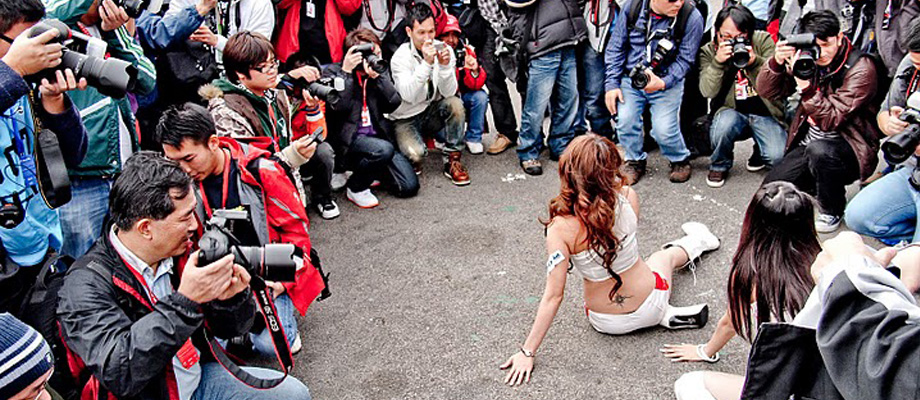
This was captured about five years ago, in Macau during the annual Grand Prix meet and the girls in the paddock were all strutting their wares (sponsor logos) and in it, I could not believe the number of photographers on hand to capture what was going on.

So throughout the three days, I was actually busy capturing content for a iPhone app and for that, there were lots to see and do.

The workflow for the winning shot is seen in the video enclosed and there was a few misses when people walked onto the frame, which happens very often.

When you are working in a hot and crowded environment, things are expected to go wrong, and with people walking all over the place, this is bound to happen.

A photo opportunity is missed because someone walked in, not caring if they were in frame and out again and as you wait for the moment to clear, that moment is history. You never get your shot.

This is why in digital, you have the option of working fast.

Angle of the frame is very important as you can see from the workflow shots in the video. In the shortest time possible, you have to nail this. And this isn't just from the perspective you want, that is on eye level.

Most of the time, photographers see scenes only from eye level. Sure you can have a variety of shots by zooming your lens in and out to frame it but going higher and lower is to me, your sense of perspective. This is what the photographer's eye is all about.

The camera I was using, a G1 from Panasonic didn't have that freedom as it was the first generation M43 sensors. I still love this camera and use it once in a while. It's dated of course, with a 12 megapixel sensor, my smartphone is a Galaxy Note 4 with 16 megapixels. So that's how far behind technology from yesteryears is.


I tried to make several shots of different crops. One was without the photographers in the picture, the others included them in various angles. The winning shot was cropped as there was someone walking right into frame.

Because the girls themselves were the main subject, the background became secondary. You basically shifted the main subject from across the frame, from center to off center to see how it works.

You cropped tight, and wide both while maintaining the perspective of the models. Remember when shooting such scenes, the environment is very fluid. They can be posing like they are now but not later. So no two scenes are going to be the same even if the models are hanging around the paddock area all the time.

Fortunately, the Sun was shining brightly, and into my LCD display which made it difficult to shoot. The color of the wings and attire just jumped out of the picture. So this was the main reason why it looked good. 

Stock Options?


The other thing is that, the photo itself has no commercial value if you include photographers in the picture, including the models' faces also means your photo is pretty much worthless when the faces are identifiable. This is main reason why I took the shot, one of the photographers shooting them for editorial value, the others without the photographers for stock image value.

To further enhance the image stock value, you have to personally remove the logos on the model's attire. A process I have yet to find time to do.

So if you happen to chance upon moments like this, think first about the sort of photos you wish to capture. Include both editorial and stock image possibilities as who knows? You might get lucky.


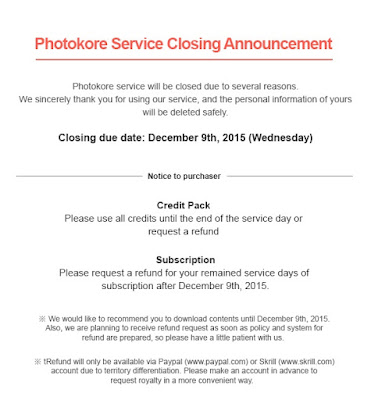
Photokore to Shut its Service in Decemmber 2015

0

It is sad to see another one go but times are a changing. Photokore, a stock image library that's been around since 2010 is finding hard to find paying customers for pictures from Asia. And by December 2015, it will shutter its site for good.

One of Photokore's strong points was it capitalized on photos made available to them from photographers based in Asia. That however hasn't translated to sales. People in Asia just don't buy pictures!

It has of course sent out alerts to both subscribers and photographers on the impending closure.


Problems with a Paying Market


One of the trends I notice is that Asia isn't a big contributor in terms of revenue to stock photography. Many prefer to lift images off others from social media and don't give a hoot until they get found out. In south Asia, where the weather remains relatively the same, you don't find much changes in the environment as say in four season countries. There are no distinct differences besides the rain and the sun shine. North Asia, aside from Japan and Korea, no one really bothers about buying pictures either. The respect for copyright is a right to copy. China, well, need I say more?

Western based markets are only slightly better as collateral has to be purchased before hand and this contributes somewhat to the revenue base. In fact, a majority of these stock agencies from the west make decent living from selling photos.

The paying market is shrinking, while the contributor base has been increasing, thanks largely to mobile photo sharing sites that have opted to jump into the stock image business.

Instagram briefly flirted with a stock image revenue model in 2012 only to have their users go up in arms about it. Now users will pay the price for this with lots of advertising. Which is the other way to get around the problem.

There is no two ways around this. Monetize or die.

Stock image wasn't the first choice for EyeEm or 500px.com but they now offer a library of photos to would be photo buyers as well. Competing and sometimes complementing big names like Getty Images, they offer a cheaper option.

Not sure how long this model will survive but there isn't much in the long term to look forward to in the stock image business as we are already been inundated with photos from around the world in social media.

I have sold some photos but not enough of it to pay rent. That's my observations so far and I don't think it will change in time to come.