Showing posts with label Street photography. Show all posts

Why Photography should be Enjoyed as a Hobby

0


There is always this myth that your hobby should pay for itself either as a form of investment. People who collect stamps as a hobby a long time ago saw the value in that which they collected. While people who painted saw value in their art but that's not always the case of course with digital photography.

Some of you enjoy a hobby for the sheer pleasure it bring to you and if photography is on that list, it should remain that way. 

In the age of the Internet and social media, it has become apparent that images make for a good story of your passage through the many places that life takes you. I have a friend named Peter who loves food, and he take pictures of them. It has never occurred to him to make that a paying hobby and he never sells what he shoots for stock image sale. 

I have this other guy named Alan who loves collecting old film cameras and using them Although I have never seen a single picture that he has taken nor is he one of those who constantly share what he has shot, nonetheless his hobby of shooting with film cameras has given him immense enjoyment. He's also built up an envious collection of rare cameras which will be worth a good chump of change in years to come. 

One of the beauties of a hobby is that it has to be enjoyed, and for me Photography has always been a solitary enjoyment exercise. You don't need a shooting buddy or a photo assistant to carry your loaded cameras around. 

Start with a Genre you Love


When you start shooting, it has to be on subjects you love. Some love food and they shoot food. Others have phases in their lives, which I am guilty of, and I have drifted from shooting night scenes to macros of bugs and horticulture. Once you discover a challenge worth your time, you pursue it. 

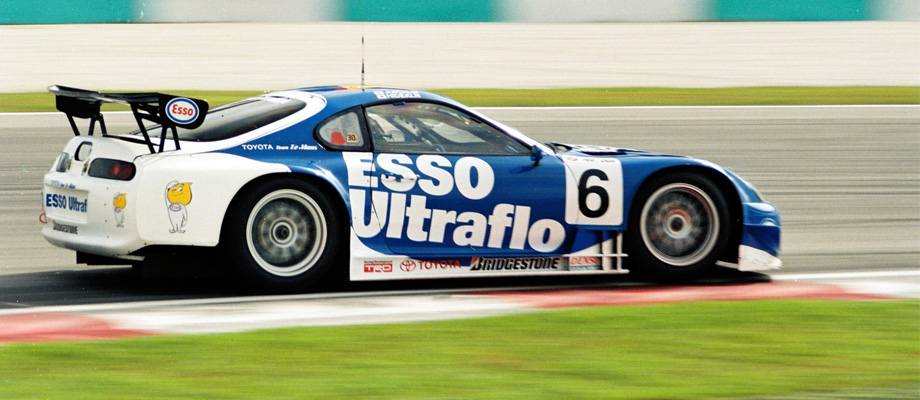
Over the years, I have gone from shooting garden variety macros, to motorsports and cars, dabbled in studio photography of models to see what it was like and even gone on to shoot street photos. I was even told that shooting cars were the most difficult as I couldn't agree more till digital photography arrived and made that relatively easy. 


I eventually settled on street photography, which by definition is the worst paying form of photography today but I still love it. I have sold two street photos to date, both of which were snapped up by a hotel group but these were royalty free. 

Street is cool. I love capturing the daily life of people in urban environments but no one will hire a street photographer for a wedding shoot, or for that matter going Pro when you only have street cred on your name card. Street photography hasn't been a worthwhile vocation for a very long time. 


Why I enjoy Street Photography


When you shoot, you're a hunter. The only difference is that you hunt for pictures to keep in your camera. I had a lot of fun doing this during the 90s when I was in Hanoi, Vietnam. Three of us were out in the streets shooting what was a Soviet era of Vietnam that is very different from what you see today. 

You bagged nice little memories from the trip on the things you see around you but the truth is none of the pictures were sold. I remember passing some of the slides to an image bank and for years, they held it. None were sold. 

The secret why they were not sold is because no one would buy them. You see, photos only sell if they represent a commercial product. Even editorial photos hardly sell these days except maybe for royalty free use. 

Today, street photography pictures are still not hot sellers. It never could earn you a pretty penny unless you framed it up as an abstract piece and sold it at a souvenir store. That's quite an investment if you asked me but the whole point here is street photography isn't about making money. 

For me, it has always been about collecting memories of places that I have been. 


Keeping your Hobby Manageable

Yes, photography can get out of hand. You start to want things, like maybe a 300mm lens and accessories. Things will start to get expensive as you start collecting lenses so don't get into the habit of buying things that you regret later. 

For me, I never did have that regret even though that spiffy 70-200mm f/2.8 lens is hardly used by me, it served its purpose from another time when I shot motorsports. I did point this lens on a monkey and some local wild life but none of these pictures sold anymore than the ones I put up on numerous image banks. 

Keeping your photography simple and affordable is the key to enjoying it. There is no reason to be a gear head because at the end of the day, you'd be judged on what you shot....and not what you shoot with. 


If there was a place you could rent a lens or borrow one, so much the better. You have to develop your style of shooting and often, you only end up with carrying 2 lenses at most. Going crazy with a long list of prime lenses isn't going to make you a better photographer. It is at this point that we photos call these folks 'gear heads'. 

Being a 'gear head' isn't going to make you a better photography by any count. You may fuss over the different apertures and sensors on each camera but you come out shooting blanks as none of the pictures are any good. 

People who enjoy pictures and photography can tell if you are a bad photographer by looking at your images. It is something that photogs know and they won't tell you because they don't know you well enough to tell you in your face. Why bother?


Think in Pictures

I find that visualisation helps you see things better when it comes to framing a subject. 
This is an exercise in creativity as you visually place the subject in the window of your mind and see how it would look before taking that shot. 

Some like to squeeze a few shots in every angle imaginable and hope to get lucky with one. That's not helping you train your mind. As a hobby, you need to let that spark in your mind do its magic. Once that comes naturally, you're good to go. 


Leica's 100th : Luxury in Photography

0
I love Leica lenses. Having owned one, you'll find that there is something really exquisite about the imaging quality. The color, contrast, and clarity is superb. So Leica is celebrating 100 years in photography. Wow. That's a long time. Looking back, one can't help but realize how much photography has changed since then. 

Today, the average digital photo is pretty much worthless. To buy one for use on your website, you pay a dollar for royalty free rights. The only people who seem to be making money from it all are the stock photo agencies who charge you that dollar to download an image. 


Leica has moved away from film to digital. Good for you. Look at the spiffy new Leica 100th D-Lux 6 with 5,000 of these will be sold world wide. That said, it will be a collectors item. I don't want to go into the pricing. You can't do that with a Leica. It has a great lens and that should cost you in the ballpark of a full frame DSLR alone. 

To pay that much for a camera speaks volumes of Leica photographers. Rich, affluent and probably a point and shoot enthusiast. You are not going to be the next Alfred Eisenstaedt or Robert Capa. 

Instead, we find Leica indulging their fans with Street Photography and offering courses and exhibitions for would be street photographers. This genre of photography was made famous by HCB, who in his free time spent hours upon hours on the streets of Paris. But Leica, haven't you noticed that the people who buy your cameras do not necessary venture out to the street? 

The typical Leica user would probably avoid spending too many hours on the street as his Leica gear would cost more than his left kidney on the black market. You can go to a cafe and the moment you put down your camera bag or gear, you'd be assured it'll be gone within a few minutes of you taking your eyes off it. A Leica camera is like magnet for thieves and robbers. Unless you venture out with a shotgun in tow, chances are people everywhere will try to rip you off. 

Lastly, why Street Photography? As a career pursuit, it won't be as financially rewarding as Paparazzi Photography. Even wedding photography makes more money on a regular basis than any street photographer. You should be aware that the constabulary of every Western country has an axe to grind with people who point cameras in the street. Post 911 they say. It's a sign of a would e terrorist. 

Then there is the privacy issue. In Hungary, it is illegal to take photos of people on the street without their consent. In the age of the NSA with eyes on your Facebook profile, you'd be happy that your face doesn't appear in a picture on Flickr captured in a embargoed country. 

What's more street photos are often made up of people, with recognisable faces. This means that if you ever tried to sell a street photo as a royalty free stock image, you'd be asked to supply a model release. You can of course take photos when there is no one around. For this, all you have to do is wait till the eerie hours of the night to do so. But I understand that Leica cameras don't handle well in low light, so are you saying that this is a myth?

Regardless, I think you are doing well financially as a camera manufacturer. Those limited edition cameras are genuine rip offs but hey, let's keep that a secret between the both of us. I still think you make fabulous lenses and I am addicted to them. Saves me hours behind the desktop trying to enhance those digital images on Adobe Lightroom. For this, let me wish you a very Happy Birthday, and let the good times roll. 


BEST KEPT SECRETS OF STREET PHOTOGRAPHY

1

As a writer cum photographer, I have done my rounds as a photojournalist whenever the call came up and for that, I have never found it as a means to make money from it. It was part of the job. People often ask me about shooting street and I tell them that you need to have a few qualities before you embark on your quest. First, let's be clear photojournalism is about observing life through the lens and in many ways, it is the same as Street Photography. You don't make tones of money from Street Photography, and unfortunately in the West, you can even get arrested for just having a camera pointed at some place within the city. Cameraphobia as I call it, need only apply to big city places like London or New York. If you have a natural affinity for observing people, you'd pick out interesting scenes to frame your pictures but the best kept secrets are often ones that you tend to ignore. 


Don't Attract Attention

A rule that is often ignored as you lug that huge DSLR with a massive Zoom lens.  People like to pretend to be some big shot photographer and become the target of thieves and police. This is not the way to do Street Photography. As much as possible, people should not know you're capturing pictures. Use a smaller camera when possible and learn to blend in instead of stand out. Smaller cameras too have smaller zoom lenses with equal magnifying power, so there is no excuse for carrying that bulky DSLR. 


Use Fixed Lenses

For a change, be limited by your equipment and see how you can best adapt to that situation with a fixed lens camera. In the old days, a 50mm lens was called a standard lens and the preferred choice of all street photographers. HCB of Magnum was famous for this. So if he could do it, why can't you? 

Shoot from the Hip

A lesser known method is to shoot from the Hip and with a fixed lens, it is so much easier. Shoot from the hip is precisely that, you trigger the shutter when you "feel" a picture is happening before you without peering down on your viewfinder. 

Some of the best pictures may not happen at eye level and you have to feel your way around it. If you were born a Hobbit, then it's eye level. 

Once you get accustomed to the field of view of a fixed lens, it becomes very easy for you estimate the length and depth of your subject. It is not a precise way of composition but the results are sometimes quite surprising. 


Street Photography Tips

0


Street Photography is all about developing your photojournalistic eye. So what is this photojournalistic eye? Well, they are quite easy to learn really and it's not rocket science. Anyone can learn it and you can master this too if you paid attention to these few tips.

Observation

A good photojournalist must have a keen eye for observing and anticipating movement within your environment. When you sit alone in a park, what is it that you see? By identifying possible subjects for your camera takes a keen sense of observation. You have to train your eye to constantly search for subjects,

This picture would not be very interesting if it just showed the food instead of having the street vendor present in the picture. The background restaurant element is a bonus. Captured in Seoul, South Korea. 

Story Telling

If you had a picture of a city street, you have to ask yourself if the picture on its own is able to tell a story. Similarly, I feel that having a human element in your picture enhances the picture as it gives "life". An empty stall with just the food would be extremely boring even though some may find the spread tantalising.


Stall owner in Seoul manning his food stall

Story telling has always been about pictures of people in different places. By having human subjects, you add that bit more into the picture to give it depth.

To do this successfully, you need to have patience as nothing happens immediately. People in street photography are not posed models. They come and go as they please and your ability to anticipate movement is what makes it work.

Sometimes, the timing may not be perfect but with patience, you can be rewarded. The picture on the right is a good example. If I had shot this frame earlier, the woman would not be in the frame and what you have is an empty storefront. By waiting for a human subject to enter the frame, the story telling bit has been fulfilled.
 Composition

This is probably the most misunderstood element in street photography. How you divide the frame to place your subject is very important. If the picture doesn't look right, it is because the subjects are out of sync.  Subjects in the picture can be delineated by lines and segmented by color, space and texture. Some photographers have even used "mass" as way to define an object's place in a frame. To me, it's just the same difference.

Stall owner falls asleep on a hot summer's day in Macau

Street photography

0
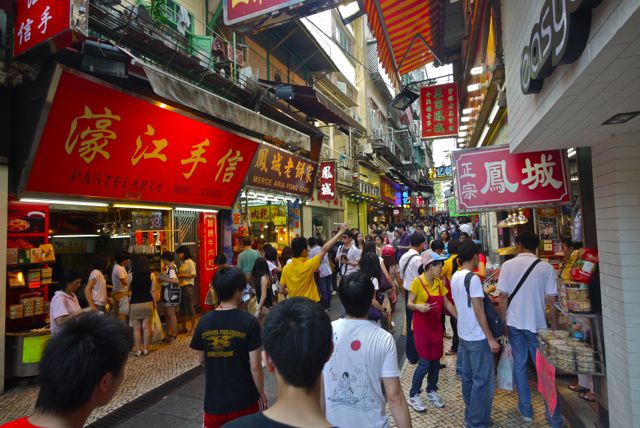
These were shot using the new iPod touch. It is a very good street camera because it is small & you can wear it around your neck without attracting too much attention. Don't use flash if possible and you just gotta be sneaky to know when to shoot. I don't like people looking directly into my camera when I capture them, reason being they should not be aware that you are pointing something at them. Some of the best places to shoot street is within the city, where you find a hive of activity.