Showing posts with label olympus. Show all posts

Olympus gets Nostalgic with the new Pen F

0
Nostalgia, that's what it is when it comes to owning the Pen F.

I have the analogue version of this camera that gives you 72 shots from a roll of 36 frame film. And there are many similarities with the Pen EP digital cameras but the one that comes closest is the new Pen F, which unfortunately is going to confuse the hell out of you.

The new Pen F, and I say new because it is a digital camera, looks very much like the old one and consumers will no doubt be kicking themselves when they go searching for it on google. The problem is that both share the same name.

This is the film camera, not the digital one


The new Pen F isn't cheap. It cost 1,200 bucks....in USD. In terms of technical specs, you have a new 20 megapixel sensor in place of the 16 megapixel one found in the EM5. No weather sealing for the Pen though.

  • 20MP Live MOS Four Thirds format sensor
  • 5-axis image stabilization with automatic panning detection
  • 2.36 million dot OLED electronic viewfinder
  • Up to 10 fps continuous shooting (20 fps with electronic shutter)
  • Highly customizable interface, twin controls
  • Fully articulating 1.04 million dot, 3" LCD touchscreen
  • 50MP High-res Shot mode
  • 1/8000 sec top mechanical shutter speed (1/16,000 with e-shutter)
  • 1080/60p video recording

The next drawback is the lack of 4K video, which is kinda sad if you asked me as video shooting is now a requirement for most cameras. 

The Pen F like its predecessor released in the 60s are designed to be used like a Rangefinder camera. You can keep both eyes open while keeping one in the viewfinder for framing. 

This means it is a street shooter. And not being a DSLR type camera makes it less useful if shooting commercial photos. I am pretty sure the AF is on par with some entry level DSLR but that's not the point. 

Selling Nostalgia

This is something which camera companies are now innovating though I am not sure how attractive this would be. Remember years ago when Nikon released the Nikon Df? How many actually liked it enough to buy one?

Olympus thinks it can reinvigorate the product line with a new Pen F line. I can already see a second generation Pen F with 4K video shooting if this one succeeds but I can't say I will be putting my bet on this. 

Digital cameras don't offer you much these days as the shooting experience is pretty standard with other digital offerings in the market. The only difference is that digital cameras will get more expensive since there are fewer buyers.


The craze from 7 years ago is truly dead. Nostalgia is probably the secret ingredient they hope you'd buy into as camera companies desperately need your money to soldier on.

So will it work? I really do not know.

Digital cameras are tools for the moment. If you want something of real value, you should take the Pen F analog because that is one camera that really rocks.

The resurgence of film photography will gather speed and in time, no one would remember the digital Pen F.

But in the mean time, Olympus needs to get its sales cracking and there is no better way to try than to give it the film look. 


Shooting with the Olympus Pen FT/F Film Camera

0


Olympus Pen FT half frame film camera 


Film cameras are pretty cheap to procure from eBay these days and for me, I wanted to experience what having a half frame camera would be like. It's moments like these that challenge you as I have shot on 35mm film but never in half frame. The reason was simple. I didn't have the money to buy a half frame camera and had to settle for a 110 type compact film camera. Moving up to a 35mm camera was my next step up the ladder as by that time, the only half frame camera still selling was an automatic Yashica Samurai. It looked perfectly space age but I felt something wasn't right. It just didn't look like a real camera!


This is a single 35mm frame, captured by a half frame camera

After doing some research, I settled for two classics from the 60s, the Pen F and FT. The difference is one comes without a light meter while the other one has one built in. The F model was the first and chirpy to use. The viewfinder is bright and the lenses are pretty good. So good in fact many idiots ended up selling the lenses to MFT digital mirror camera users, leaving the bodies behind to gather dust. That means you can get plenty of F cameras but they are without any lenses. 

To be fair, there are Nikon F mount adapters as well as OM Lens versions. The problem is the availability of these mounts are pretty hard to come by these days. After all, the camera is close to half a century old (I must admit that I was born after the camera was introduced to this world). 

Having had experienced some of the best full frame film cameras like the Nikon FM and F4, going back to a camera that takes half frame is a bit disconnecting. Both the Pen FT and F are SLR type cameras, the only difference is that they have a very different type of lens arrangement and the FT suffers from a much darker viewfinder as some of the light has been siphoned off to power the light meter—making it a shade darker. This also means that in low light scenes, it will appear a little more difficult to focus. I prefer the F's focus screen as it's split screen so you can nail the focus faster than the FT. 


Anyway, if you want to start shooting with half frame pen cameras like the FT, and F, here are a couple of tips. 


Do not use a film faster than ASA 400 


ASA 400 film has more grain than ASA 100 film, so it goes to show that it's better to use lower ASA film to get a better result. The larger the grain, the more it will show once you enlarge the frame. 

Another thing is that film stocks differ too. For example, negative film has less contrast quality than compared to slide or positive film. You need to know the types of film and their quality before hand to get the best out of them. No two film stocks are alike.

Even for B/W film, those processed specifically in C-41 color chemicals exhibit a lower quality of contrast than those processed specifically with B/W chemicals. 

Some people even shot slide film with the half frame camera and there were half frame slides that could be used on slide projectors at one time. Slide film would be awesome but exposure would have to be spot on. 


Crop your scene in the camera viewfinder

Subjects like city skylines and landscapes are poor choices for half frame because you have a much smaller image to play with. In terms of distance to subject, the best are within 15 feet from your camera. If the subject is too small within the frame, you will have to crop it to make it look larger and unless you get high quality scans at 300dpi and above on positive film, chances are those images won't be suitable for further cropping when captured on negative film. 


this is a tight crop with the whole subject area filling the frame


In a full frame 35mm slide or negative, you don't have this problem as the film area is twice as large this allows for better clarity and composition as you can still crop the frame for a tighter composition and still have plenty left over for a good print. In half frame, you are discouraged from doing this as cropping it further will not enhance the detail and clarity as you are already stuck with a smaller frame. Blowing that up will lead to more dot grain. 

You have to think in terms of how much can you enlarge your half frame image before the quality starts to suffer. In camera cropping of the scene to fill your frame is recommended

Always use a Light Meter


Got an iPhone? Cool! Now download that light meter app that lets you use your iPhone measure spot exposure. The Pen FT has a built in meter but the F only comes with an external one. The problem with the FT meter is that it is not entirely accurate for spot readings. In light meters apps there are two varieties. 

The incidence light meter measures falling light from a source while a spot meter measures light at where you are pointing. The incidence light meter has a diffusion dome for a head while the spot meter uses the iPhone's camera to measure light from a desire location. It's not the most accurate but it does fine for general lighting but when it comes to high contrast scenes you have to take several measurements using the Zone System to best bring out the hidden details. 


Kodalux and Voigtlander lightmeters for film cameras


The zone system of film exposure tells you to measure both the highlight and low lights to ensure that the details are captured on film. 

You can also get those analogue light meters but the new ones are more accurate. Take for example the Voigtlander meter, it is very accurate and uses 2x LR44 batteries. Whereas the Kodalux doesn't use any batteries and can be subject to wear after the photo sensitive element wear out over time. 


Scanning and Post Production

Developing a roll and having it scanned is relatively easy but I must warn you that some photo labs don't do this. You need to have someone who has a color lab that also caters to the needs of film photographers to get high quality scans as most of the scanning done through color lab process is of a lower quality. 

I have not shot these on positive film but these will pose a bit of a problem as half frame slide mounts are very difficult to come by these days. In the old days, there were easy but I have only come across one or two sellers so far on eBay. 

That's not to say you can't shoot with positive film using half frame cameras if all you want is a scanned image for sharing and a physical slide frame for archival purposes. 

The half frame camera is quirky at best, something which you should be aware of from the very beginning. It's probably quite good for street photography and anything casual but wide angle shooting like landscapes and cityscapes would be extremely difficult to achieve. 

For one, the wide angle lenses from Olympus for the FT and F cameras are extremely expensive...it's probably even next to impossible to get them now as can be seen by the relative prices of these lenses once they are available on eBay. Wide angle is probably the half frame camera's weakest point, and it shows. 

When you scan, and depending on the scanner used. The scanned image is no larger than 4 megapixels if you are using a 8 megapixel full frame scanner. You must not forget that you will lose picture quality once you start to divide the image in half. Bummer....but that's how it is. 

The last hurdle is really the lenses for the Pen F. These have become very hard to come by over the years because mirrorless camera users have been snapping them up. That also means there are a whole load of F cameras that sell without any lens and you can bargain that down cheap. To use, you will have to find a way to obtain a lens mount for full frame Nikon or Olympus OM lenses which is also relatively difficult to find these days. Besides this, shooting with a half frame is really an experience where you can learn to appreciate analog photography. The challenge is what you should be looking forward to as the mere click of a shutter to get a picture can easily be satisfied with just your mobile phone camera while the same can't be said for film cameras. 
 

Pen F, note the F motif. This is the first model

Sony's A7 Woes, the time has come to stop the Rot

0

Was the product rushed? What about the light leak issue? Was the promised firmware update released to address more issues with the camera?

I can't help but feel that the product was rushed to market without proper testing. I know Sony well, having worked with them in the past on several cameras, they seem to like to gloss over some of their weaknesses time and again. Their chief problem is that they want to catch the buying wave of consumers.

The A7 series is no different. A full frame interchangeable camera that is not entirely a DSLR, and yet, gives the impression of having a full frame quality imaging is probably the best snake oil they have sold to the masses so far.

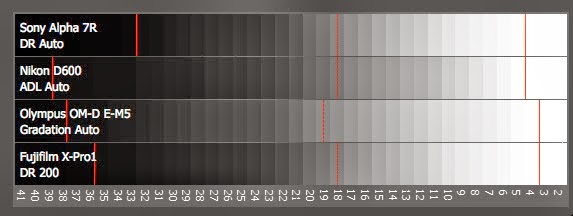
I did a little research on the dynamic range capability of the camera. This is measured by dpreview.com and all you have to do is select the suitable camera for comparison so I don't use any crafty methods to debunk any myths.


If you look at the above chart, the A7r performs very poorly in dynamic range charts. Compare that with the Nikon D600 in auto mode, you can see the difference. I have also taken the liberty to compare two other popular cameras, the OMD-EM5 from Olympus and the Fujifilm Xpro1. The Xpro1 doesn't have a auto mode so I have selected a ISO 200 setting. Dollar for dollar, you can't beat the Olympus OMD EM5 in dynamic range capability.


What Dynamic Range doesn't offer you

Dynamic range charts tell the sensitivity of the sensor in capturing light in both the highlights and shadow areas withint a picture, it does not tell the deal with issues such as  noise reduction algorithms or color accuracy.

I care much for high ISO as I rarely ever shoot above ISO1600, having ISO 6400 is useful if you are a professional but I don't have such a requirement on my day to day shooting.

Even in low light, I prefer to use a tripod for the camera and shoot at a slower ISO. I don't shoot dance or music concerts very often, and for that I have no need for a high ISO and even higher shutter speed to stop motion.

The dynamic range chart tells a clear picture that the Sony A7r is not a good camera to use in high contrast scenes even in DRO mode, and you probably have to use HDR capture to get more out of your images, meaning...you need to carry a tripod for a three frame capture.

Do you need another camera?

I am of the opinion that you should have two different cameras to cater to all your shooting needs. The casual shooter only needs an iPhone to get good results in daylight, and the second camera should address the weaknesses of the iPhone in everyday use, like poor dynamic range, poor shutter speed response and poor noise handling, and poor low light response.

Say you have a good iPhone/Nokia Lumia 1020 for your everyday use and want something more. Then your best choice is to consider your shooting requirement, ask yourself this:-

How often do you shoot in low light?
Do you shoot action subjects?

These are the only two question that is pertinent. Fast AF and shutter speed is probably the key to your action requirement, while in low light, you need to handle  such shooting with a combination of low light capability and high ISO capture.

What does Sony Needs to Do?

Address their weak points, namely poor high ISO handling and dynamic range. Their noise reduction algorithm stinks, and DRO was something they were bragging about when I worked with them on the A700 Resource Portal. It sounded very futuristic then but today, as you can see form the poor dyanmic range results, it has taken a severe beating.

Sony cannot rely on their mass market brand name alone to sell cameras. I still do believe they are able to come out with innovative products but the performance issues often associated with it leaves a very bad aftertaste on the consumers who have bought into them.

A product must be sold on its strengths and not price points alone. A full frame camera like the A7r looks tempting at that price but the performance of the camera is less than desirable. The rush to put more pixels into megapixels must stop. Consumers will get tired of the same sales pitch and turn to their smartphone cameras instead, when this happens, Sony Alpha Cameras are doomed.