
My Life in the Fast Lane, a photographic journey
0

In another life, I was a championship winning team manager and with it, I carried two cameras with me on my many trips. Most of the time, I would shoot with a 5 megapixel Nikon 5700, and as a back up, I had a Lomo LCA film camera. For me, the cameras were tools to help with the communications aspects of the vocation.
The two are indistinguishable as a tool. I felt right at home shooting on both mediums, though I did find the zone focus system on the Lomo a bit limiting. Digital was useful. It gave me pictures of the car and driver whenever someone from the press wanted them.

First, I must tell you how I came about as a team manager. I was head hunted for the job during my stint as an ad-hoc PR consultant for Johor Circuit. My involvement in motor racing at that point had been editorial and communications, and previously to this, I was the Media Officer for the Rally of Asia. For that role, I took a whole load of pictures which were later used as the main content for newspapers as the official photographer appointed for that event actually fucked it up badly by just taking pictures of cars on the dirt road.
My reputation as a race savvy manager was unknown to me but people within the industry saw that I did good work so why not double down on the position of team manager. This came about in 2003.... for the inaugural Porsche Carrera Cup Asia Championship.
 |
| Charles Kwan, 2003 Porsche Carrera Cup Asia Champion |
The role offered to me was simple enough, I could learn on the job and do the motorsports communications for Novellus Infineon Racing based out of Switzerland. Infineon was run by a bunch of Porsche fanatics and they had decided to compete in all the Carrera Cup Championships all over the world. The communications part was very small, I wrote press releases for the races and had that emailed to Switzerland.
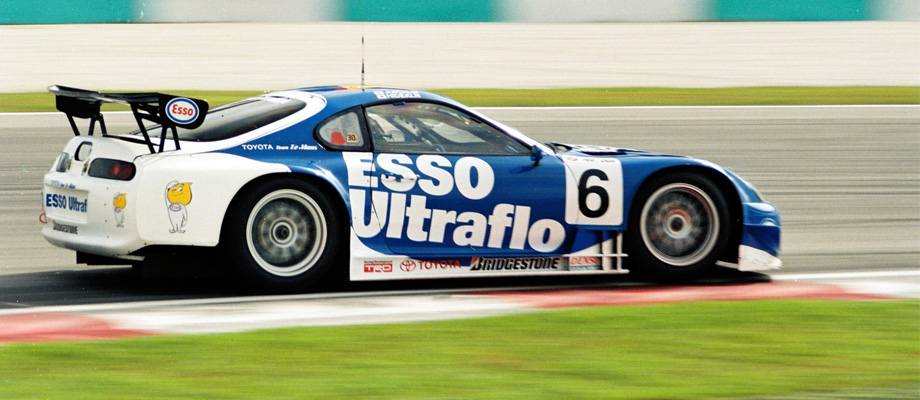
I didn't have to submit photos but I did take them on the side. Charles Kwan, the team driver with five asia pacific touring car championships under his belt was very accommodating. He would tell when when he's free for some pictures and I would take them for use should the sponsors asked. This happened like clock work. Sponsors are your patrons, you must always live up to that expectation with the necessary photos in hand.
 |
| Damaged fender was replaced with spares, hence the white colored parts. Sepang Circuit 2003 |
I loved doing photography but the opportunity to shoot were rare. most of the time you were far too busy with team affairs to worry about a photo opportunity. Regardless of what you think, there isn't time to do justice when it comes to your job. Once you get to the circuit, a whole routine had to be run to ensure the car and driver is at optimum for the race. There are no short cuts because if any irresponsibility can cause someone his life. Then there was the press, who badgered for time to talk to the driver. A photo op maybe? Yea, sure once we are finished doing what we are suppose to do, that is to win races.
This meant that I never had the time to shoot the car when its out on qualifying trials or at free practise. It would be irresponsible to do this for the sake of fun.

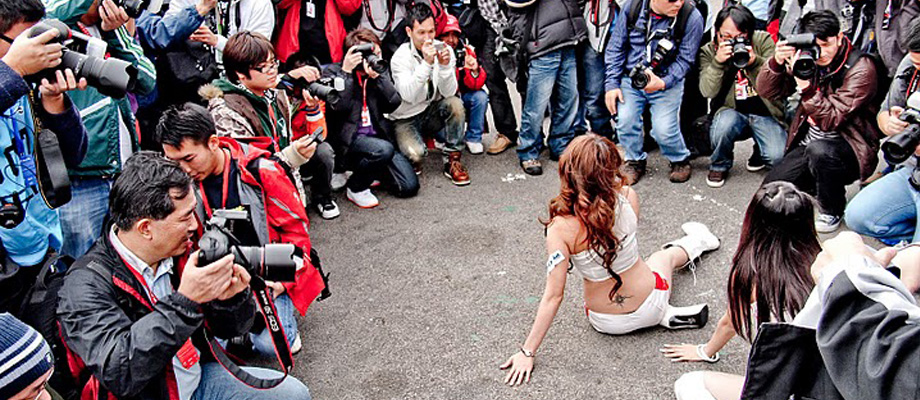
During the quiet moments, sure you had the time to photograph the models, and models here don't mean cars. These are girls who don sponsored labels on their attire for photographers who work within the paddock area. Everyone else will have to use a long telephoto lens to get a closer look. As a team manager, you look like everyone else who worked in the pits. Not a very attractive proposition but you have to get your hands dirty all the time. I had to wheel in the racing slicks (tyres for racing use) which had to be checked and verified as we were limited to one new set per event.
Why Motorsports is Dangerous for Photographers
Getting paddock access is very difficult for safety reasons. Photographers or spectators usually get a pit walk at some point on Saturday events but that's not a given opportunity. Some tracks prefer to keep spectators where they can control them best....at the grandstands.
Press photographers have photog nests around the circuit where they can hide out until the cars come racing round. They get to stand in the hot sun, have their skins toasted to a golden brown in the process. But this was fun to them. It was also highly dangerous as cars do go sideways and with it, take any standing photographer nearby up to meet their maker. Thankfully, none of the accidents we had during the Cup races were fatal. Egos were bruised naturally but never a death.
But that's not to say it didn't happen in other racing events. I know a few who were involved in such unfortunate events. A fellow driver in the Porsche Carrera Cup had one bad experience where his Ferrari caught fire and the Marshals came to help put the fire out. A speeding car took three of them down. All of them died. This was in Macau. A place famous for its unforgiving street circuits and was the last event for the Porsche race.

Photographers normally don't get both track and grid access. Those who stay on the grid are a different kind of photographer and those shooting on track are strictly for circuit action. The races are far too short for photographers to get both track side and grid access. A sprint race like the Porsche Carrera cup last only about 30 mins at most. In accident prone tracks, this could stretch longer but it depends on the circuit length. There is no time for a photographer to run around a circuit to take scenic shots. It is possible in Formula One, where the races stretch over an hour and a half at times.
 |
| Chandra, our car mechanic has a last word with Charles before he goes out to race |
Keeping the Cars Clean and Shiny
You have no idea on the extremes we have to keep the cars clean. After all, the sponsors want their brands to stand out so every time the car goes out, the scratches on the logos and damages to the car must be inspected and if possible, changed at a moment's notice.
We had a box full of decals on standby and once there was a altercation on track, we had to change the front bumper and replace all the stickers. In Beijing, where we had a race at Goldenport motor park and had to clean the car every few hours because a thin layer of desert sand had deposited on the car. It was such a nuisance that we eventually covered the car up in a Porsche issued custom cover before we left for the day to avoid cleaning it again the following day.
Keeping the cars clean and beautiful is really about that photo moment. People would snap pictures and post it around and that's what we want. It's all part of the sponsorship package.
 |
| Charles Kwan and Benard Quek |
To be frank on matters of responsibility, the only time you can have fun with the camera is when the race is over. During that time, you take pictures of the paddock area, fellow drivers and even friends working with competing teams.
I didn't find much use for the Lomo but it was a useful off track camera. For me, the idea of shooting your journey through every event was a challenge to say the least. There were gaps as you were far too busy to shoot or when it rained like the monsoon during our race in Johor, Malaysia. None of the cameras would have held up to the rain so no point taking them out. To properly document the journey throughout the season, you would need to have a dedicated photographer, which we didn't have a budget for.
I didn't even have the time to fully appreciate Macau, our last race of the season. But we won and that's what mattered. We won the championship by just two points. It was a hard fought battle from Malaysia, Thailand, Korea, China and finally to Macau.This was a beautiful place, charming to a fault, and with a lovely mix of cultures. The pictures I took that time left an impression on me but those are my private memories. Korea was nice but the circuit was located too far from civilization...at the Taebeak mountains. Going back to Seoul, we had a few days to enjoy the wonderful city. Charles met up with a Korean actor, Jung Woo Sung, and I whipped out my Lomo for that moment.
 |
| Actor Jung Woo Sung with Charles Kwan, captured with a Lomo LCA |
Using the Lomo was a hit or miss affair. The film I used suited the moment but there were times when the Lomo let me down. I did carry both cameras with me but somehow, it's always the film cameras that leave an impression on your because they are so darn hard to use when you are in a hurry.
 |
| Lomo moment in Beijing Goldenport Circuit |
At the end of the race in Macau, I did the right thing which shocked a lot of people. I announced my retirement from motor sports. I always felt that you should retire when you are up there with the best and I am glad I did. Those memories that I have are still around in my photo album, and boy that was one helluva ride.


.JPG)


