Showing posts with label motogp. Show all posts

Shooting Speed: Motion Capture on the Fast Lane

0

Speed. For professionals who hang around the track all day shooting racing cars, you pretty much end up with the same type of images because you are restricted by the angle that you are allowed to shoot. Often you find the same type of images floating around on the Web that shows some kind of speeding vehicle frozen at the exact moment in time. For stuff like this, you can't capture this unless you have a DSLR capable of up to 1/2000 of a sec shutter speed.

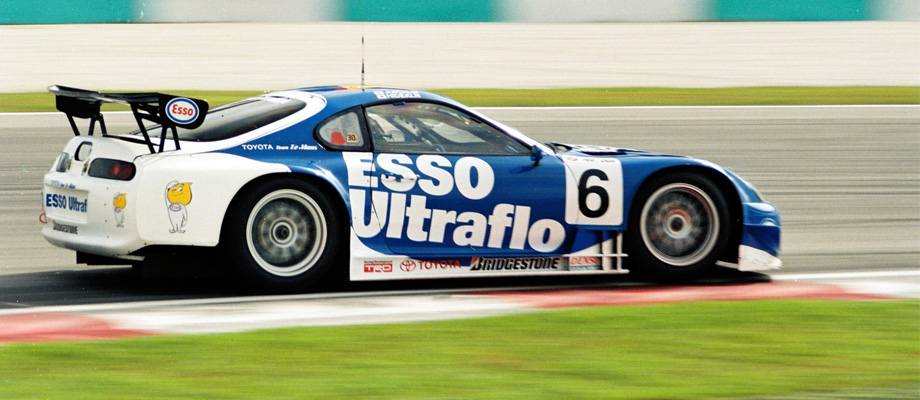
For me, I prefer shooting motion rather than freezing them as this gives a different look to the images instead of the same old, same old styles seen everywhere from billboard advertisements to print and web advertising.

When I started shooting these, I was still shooting on film. Imagine what I could have done with digital as it would have been a whole lot easier with the top of the line DSLRs you have today.

But the way forward is still the same. You gotta know your shutter speed. For motion capture like these, you need to know how to pan the camera.

Panning, as you follow your subject through a fixed path of motion, is what gives you the ability to capture speed and motion in your pictures.

Motion Capture Tips


  1. The best shutter speed to capture motion is 1/125 sec
  2. Make sure your subject is moving in a parallel line to your panning movement
  3. AF should be OFF (if you haven't got a spiffy DSLR with super fast AF)...AND 
  4. Prefocus your Distance to Subject
  5. Use a Monopod to steady your panning

The aperture value is irrelevant as long as there is sufficient light. If there isn't then dial up your ISO to 1600 and preset your Shutter Speed to 1/125. In the days of film, photographers were handicapped by the film speeds of between ASA/ISO 100 to 400. Shooting with ISO speeds of 800 were not widespread due to the grain. That is irrelevant these days with digital cameras which perform well with minimum grain at ISO3200.

Minimizing Background Blur at 1/250

Seems like it is frozen but notice that the wheels are turning
For others, you may want to minimize background blur by shooting at a slightly higher speed of 1/125 just to get the wheels in motion. This depends heavily on the distance to subject and of course the telephoto lens you are using. Shorter lenses (200mm) will need to capture at shutter speeds of 1/125 whereas longer telephoto lenses (above 300mm) will require shutter speeds (between 1/250 to 1/500). Longer telephoto lenses tend to magnify movement so less panning movement is required. The movement is very much amplified at longer telephoto lenses, say between 300mm to 800mm so you need to judge the speed in which the car or bike is carrying on a straight or around corners. The important thing here is to mount your gear on a monopod. You could also fashion a monopod out of a Tripod if you didn't know any better. Just don't use all three legs and only extend ONE of the legs out to help you balance your gear. Hand holding your camera is no recommended at longer focal lengths.


Shooting Around Corners

Motion panning can be done around corners as well but the effect is different, meaning that the subject is less sharp and appear to be blurry. That's because you use a slow shutter speed of 1/60 sec.

All vehicles will have to slow down to take a corner and when you are sitting smack in the middle of one, then you will be using a wide lens instead of a telephoto lens. A standard 50mm lens (full frame) would suffice.

You can of course use a wide angle lens such as a 35mm or 28mm if you are really close to the action—like when you can extend your hand out to touch them but that is rarely the case with racing circuits.


Freezing Motion

When you have a DSLR capable of 1/2000 sec shutter speed. It is very easy for you to freeze motion. You can also freeze motion at 1/250 when the vehicle is in low speeds around corners.


This is probably the first place you will find most trackside photographers camping out. They will of course choose the same angles as everyone else as action shots don't really differ much from one location to another when you want to freeze the action. Getting to a high or low place depends on your access to the track. If you have clear access to trackside shooting spots, you will probably get a chance to use a longer telephoto lens on dedicated racing circuits.

Street circuits, like Monaco and Macau, require lower telephoto ranges, around 200mm and less since you don't have a lot of places on the track which you can fully utilize 300mm. The most common uses for a 300mm lens is a head on shot during the start of the race as all the cars are bunched up together running into the first corner. After this, you'll have to pick out your targets one by one as the race progresses.


Shooting on Film is more difficult

0
 I am often reminded how easy it is to shoot in digital. Just dial in the auto mode and fire away. You can't go wrong especially if you have RAW file mode enabled.

That's why the challenge in photography often lies in using film. These two photos were shot on slide. The first is of Johnny Herbert, F1 driver and the second one Shinichi Ito, Suzuka 8 Hour winner and 500cc MotoGP rider.

Film doesn't have the super sharp pixel density you often see in high resolution digital cameras. The quality is different. I realize this when I was browsing the photos at 500px,com, look carefully and you'd see the sharpening and detail. Not a bad thing but it is almost unreal.

Film has its unique look. The analogue quality is evident the moment you look at it. The dynamic range is different too.

Shooting film is very challenging because you need to know what film to use. Expose it wrongly and you'll find it difficult to recover the detail. Mistakes are often fatal, and there is no turning back.

Film may have a much bigger latitude but that doesn't mean you can underexpose a frame and expect the quality to be the same. It isn't. If you overexpose it too much you lose the detail in high contrast scenes. Zone metering is probably a good way to get a correct exposure. Slide film is more difficult, with a latitude of about 2/3 of a stop. Negatives can still hold an image with a 1.3 stop difference.

I wish Kodachrome was still around. Store it well, these slides will last for ages. It was my preferred choice even when the latitude was very narrow. Kodachrome 64 only has 1/3 stop latitude and shooting high contrast scenes can be very difficult. In zone metering, where you take the darkest and lightest areas of a scene to get an average, the difference can be up to 5 stops. How you select an exposure to capture the best detail is crucial. Metering on a grey card is often the preferred choice.

I love my Nikons. The FM2 and FE2 are my choice favs. I do love my F4 too, but I don't have much time to shoot with it now that I am playing around with smaller cameras like the Pen-f.